


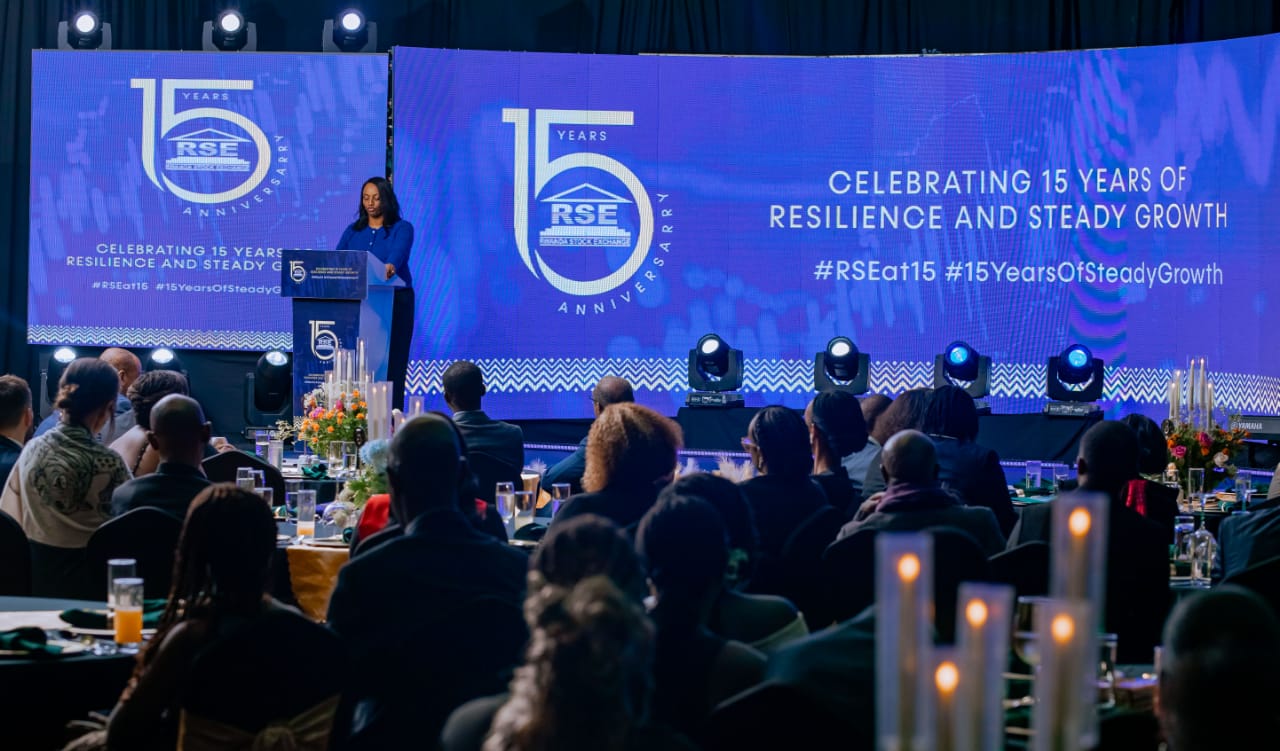
Fifteen years after its launch, the Rwanda Stock Exchange has quietly evolved from an audacious policy experiment into a financial juggernaut that has mobilized nearly $20 billion and reshaped how the country funds its development. What skeptics once dismissed as premature for a post-conflict economy has become a critical instrument of capital formation, channeling trillions of Rwandan francs into infrastructure, corporate expansion, and wealth creation.
At anniversary celebrations this week, Governor of the National Bank of Rwanda Soraya Hakuziyaremye framed the exchange’s creation as an act of institutional courage. “Fifteen years ago, the establishment of the Rwanda Stock Exchange marked a bold step in our nation’s economic journey. It reflected a clear ambition to build a modern financial system capable of mobilizing long-term capital and integrating Rwanda more deeply into regional and global markets,” she said.

The numbers validate that ambition. Since trading began in 2011, market capitalization has surged to RWF 4.7 trillion by 2025, while annual turnover climbed to RWF 340 billion. Investor accounts have swelled past 270,000, and listed companies have distributed over RWF 428 billion in dividends, marking the exchange’s growing role in generating returns for ordinary Rwandans.
Beyond equities, the RSE has pioneered green and sustainability-linked bonds, with total bond listings approaching RWF 2 trillion as of December 2025. These instruments are held by a diversified base of banks, institutional investors, and retail participants, deepening liquidity and reducing reliance on foreign capital.
For RSE Chief Executive Officer Celestin Rwabukumba, the milestone represents institutional maturity. “At 15, we are no longer young. We have come of age,” he remarked, likening the exchange to a teenager ready for higher learning.
The groundwork was laid long before the first trade. In 2005, under Rwanda’s Vision 2020 framework, the government approved a capital market development agenda designed to diversify the economy, reduce aid dependency, and build sustainable financial systems. Rwanda Stock Exchange Limited was incorporated that year, years ahead of operations, to ensure regulatory integrity from inception.
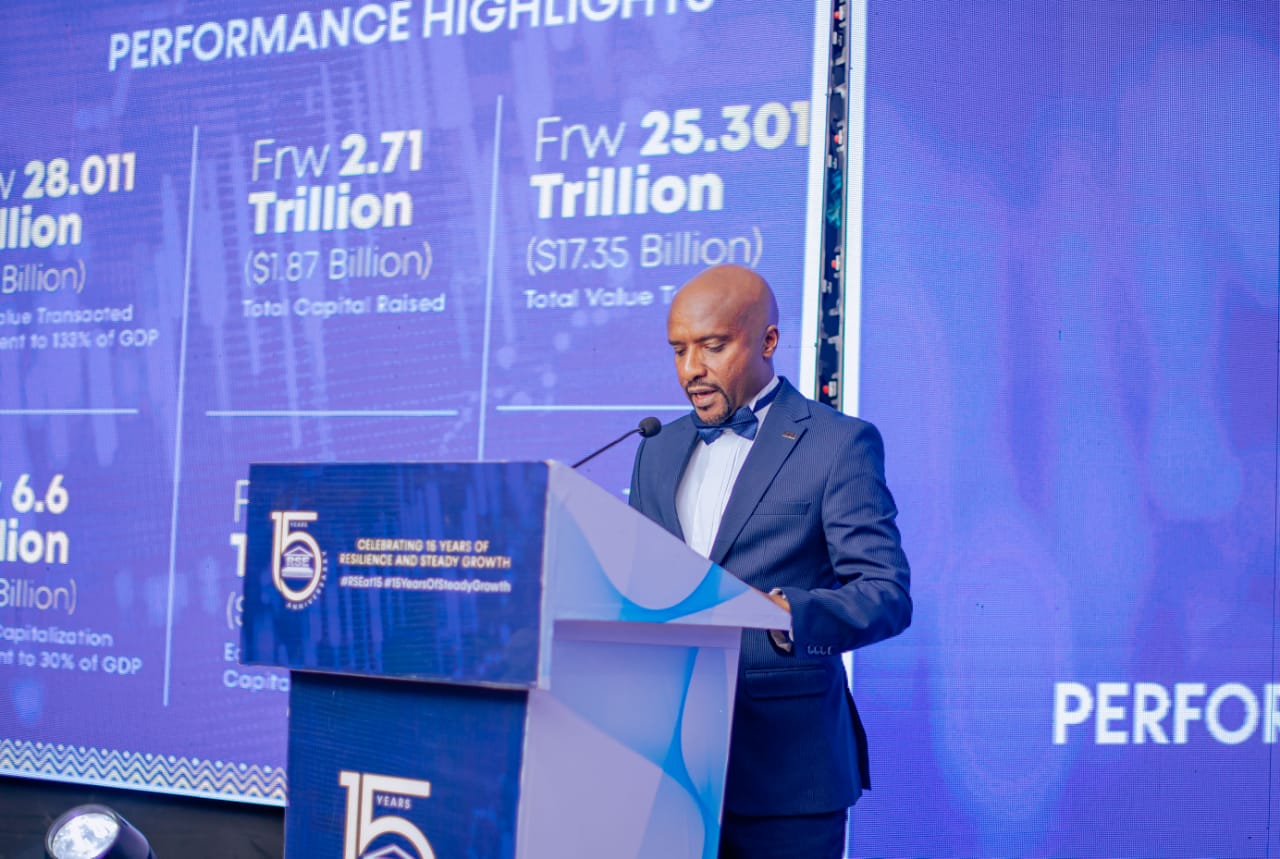
That strategic patience has paid off. Since its launch, total transactions on the RSE have reached approximately RWF 28 trillion, or about $20 billion, establishing the platform as a credible destination for both domestic and regional capital.
Why This Matters
The RSE’s evolution is more than a financial sector success story. It represents a structural shift in how Rwanda finances its development. For decades, the country relied heavily on donor funding and concessional loans. The exchange has enabled a more sustainable model: mobilizing domestic savings, attracting private capital, and giving citizens direct stakes in national growth.
Acting Chairman of the Capital Market Authority Eric Karekezi underscored this development impact. Through the market, the government has raised funds for roads, electricity, and hospitals, while companies have accessed capital to expand and create jobs. In total, the RSE has facilitated more than RWF 2.7 trillion (around $2 billion) in capital raising, equivalent to roughly 12% of GDP.
For a country that emerged from genocide just over three decades ago, that figure is not just impressive. It is transformational. It signals that Rwanda has built the institutional credibility to attract long-term capital, compete regionally, and offer its citizens wealth-building tools historically reserved for more established economies.
The Road Ahead
Despite its achievements, the RSE faces familiar challenges. Liquidity remains thin compared to regional peers like the Nairobi Securities Exchange. The number of listed companies, while growing, is still modest. And retail participation, though expanding, is concentrated among urban, educated populations.
Exchange officials acknowledge these gaps. The focus now is on attracting small and medium-sized enterprises, creating specialized market segments for startups and growth companies, and broadening investor education to reach rural savers.
There is also regional ambition. As East African Community integration deepens, the RSE is positioning itself as a hub for cross-border listings and regional bond issuances. Success will depend on regulatory harmonization, digital infrastructure, and whether Rwanda can maintain the policy consistency that has defined its post-genocide recovery.
What’s Next
Rwabukumba and his team are clear-eyed about the work ahead. The next phase involves deepening the bond market, expanding foreign-currency-denominated instruments, and ensuring the exchange can absorb larger, more complex transactions without losing its hard-won reputation for transparency and efficiency.
For now, the Rwanda Stock Exchange stands as proof that bold institutional bets, when executed with discipline and foresight, can yield outsized returns. Fifteen years on, it is no longer an experiment. It is infrastructure, and the foundation for whatever comes next.