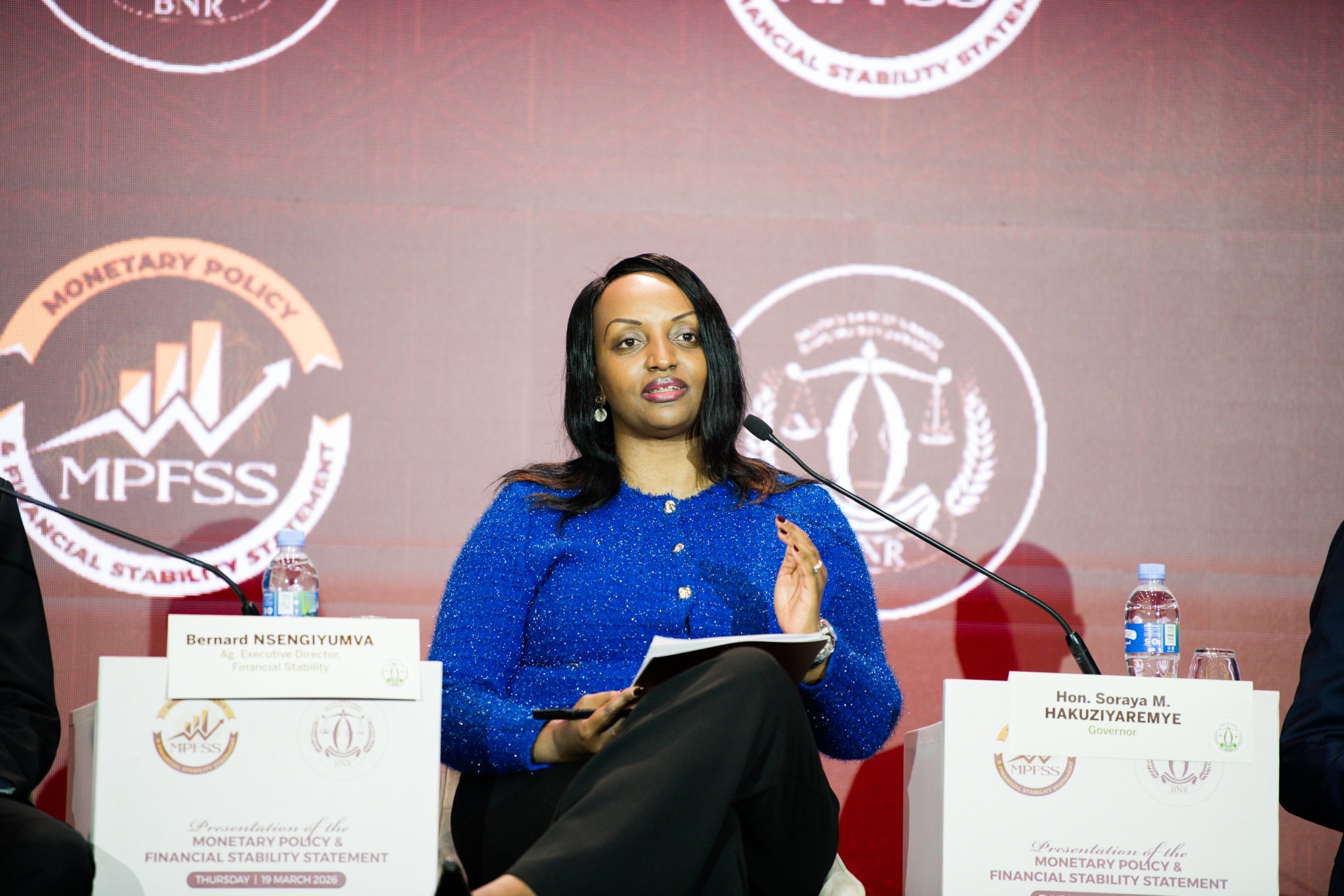
Rwanda central bank governor Soraya Hakuziyaremye during the Monetary Policy Committee briefing in Kigali
KIGALI — Rwanda’s central bank governor warned on Thursday that inflation could rise further in the near term, even as she presented a broadly positive picture of the country’s economic and financial sector performance for the year ended December 2025.
Governor Soraya Hakuziyaremye made the remarks during the BNR’s quarterly Monetary Policy Committee and Financial Stability Committee briefing in Kigali — an annual event where the central bank walks through the full picture of the economy, prices, financial sector health, and the policy outlook.
The backdrop is one of elevated prices. Headline inflation ended 2025 at 8 percent in December before accelerating to 8.9 percent in January 2026, breaching the upper limit of the central bank’s 2 to 8 percent target band. BNR raised its benchmark Central Bank Rate by 50 basis points to 7.25 percent in February — the first rate adjustment in three years — specifically to head off the risk of those price pressures becoming entrenched.
Thursday’s briefing confirmed that the job is not finished.
“What is evident is that during the first quarter of this year, prices will remain high,” Hakuziyaremye said. “However, based on our forecasts, there is hope that by the end of the year, the inflation rate will have decreased to 2.8 percent.”
She was direct about the conditions attached to that forecast. Whether it holds will depend heavily on agriculture. Improving production, expanding irrigation, and reducing the sector’s vulnerability to weather disruptions are all part of how the central bank expects inflation to come down — monetary policy alone will not do it.
The February Decision Explained
Much of Thursday’s briefing was framed around the February rate hike — what drove it, what it is intended to achieve, and where risks remain. Hakuziyaremye returned to the reasoning several times.
“This quarterly briefing reflects our commitment as a central bank to transparent, data-driven and forward-looking policymaking,” she said. “Our decisions are guided by a careful assessment of recent economic developments, inflation trends in 2025, and projections for 2026, with the objective of safeguarding price stability while sustaining Rwanda’s economic growth.”
The February decision was not, she emphasised, a reaction to an economic crisis. It was a preemptive move to stop current price increases from feeding into wages and broader expectations — what central banks call second-round effects.
“The decision to raise the policy rate is aimed at limiting second-round effects of recent price increases and supporting a timely return of inflation to the target range,” she told reporters.
She was also clear about the intent behind the original February announcement, describing it as a step to protect households directly.
“The decision to raise the Central Bank Rate is a measured step we are taking to bring inflation back within the target band between 2 percent and 8 percent to safeguard price stability which is a necessary condition to sustain our economic growth as well as protect the purchasing power of Rwandans over the medium term.”
And she left the door open for further action if conditions deteriorate.
“The MPC will continue to monitor inflation and economic developments and stands ready to adjust the policy if inflation pressures intensify beyond our projections.”
What Is Driving Prices
Inflation accelerated from 7.4 percent in the fourth quarter of 2025 to 8.9 percent in January 2026. The increase was driven by a combination of higher core prices, persistent energy costs, and renewed fresh food pressure linked to weather-related supply constraints.
Core inflation — which strips out fresh food and energy — reached 9 percent, a figure that reflects broad-based price pressure rather than a specific commodity shock. Energy inflation came in at 12.4 percent, driven by electricity tariffs and fuel. Fresh food, which had been easing through much of 2025, rebounded as weather conditions tightened supply.
Hakuziyaremye flagged three main risks to the outlook: reduced agricultural output from weather disruption, persistent energy-related cost pressures, and global and regional geopolitical tensions that could disrupt supply chains and keep import prices elevated.
“Extreme weather patterns present a downside risk, potentially constraining agricultural sector performance,” she said.
The Economy Underneath the Inflation Story
The inflation warning sits on top of a strong economic picture, and Hakuziyaremye was careful to keep both in frame.
“Rwanda’s economy has maintained strong growth,” Hakuziyaremye said, pointing to the broader economic resilience that underpins the central bank’s confidence in the outlook.
The full-year picture for 2025 is now confirmed. According to data released by the National Institute of Statistics of Rwanda on March 16, Rwanda’s economy grew 9.4 percent in 2025, well above the government’s projection of 7 percent and one of the strongest performances in recent years. GDP at current market prices reached Rwf 23,387 billion, up from Rwf 19,918 billion in 2024. Growth accelerated through the year — 6.5 percent in Q1, 7.8 percent in Q2, 11.8 percent in Q3, and 11.2 percent in Q4.
Growth is projected to remain at 7 percent for 2026, supported by services, industry, and agriculture. The Finance Ministry projects annual growth staying above 7 percent through 2028.
The financial sector ended 2025 sound. Total financial sector assets grew 23.7 percent to reach Rwf 15.9 trillion. Non-performing loans fell to 2.5 percent. The Rwandan franc depreciated at a slower pace than the prior year, supported by stronger tourism receipts, higher remittances, and improved export performance.
“The financial sector remains strong, supported by adequate capital and liquidity buffers, which position institutions to absorb shocks and continue supporting economic growth,” Hakuziyaremye said.
Agriculture as the Missing Link
One of the clearest messages from Thursday’s briefing was that the central bank sees the agriculture sector as central to the inflation solution — not just as a risk to monitor, but as an active part of the fix.
Hakuziyaremye said BNR has committed to supporting changes in loan policies for farmers, easing access to agricultural credit as part of a broader effort to lift production, stabilise food supply, and reduce the price spikes that weather disruptions routinely cause.
She said the inflation forecast of 2.8 percent by end-2026 will depend on the level of effort invested in this area. Without improvement in agricultural output and resilience, the central bank’s ability to bring prices down through monetary policy alone is limited. Higher interest rates slow demand and anchor expectations, but they do not grow food.
CABN Analysis
Today’s briefing is a public accountability moment as much as a policy update. The BNR raised rates in February, and Rwandans are asking a reasonable question: is it working? Hakuziyaremye’s honest answer is that it is too early to tell, that the first quarter will still be difficult, and that the path back to target requires things outside the central bank’s direct control — particularly the agricultural season.
That honesty is the most credible thing she can offer right now. The alternative — projecting confidence that the February hike has already done the job — would be premature and would damage the BNR’s credibility when data showed otherwise in the months ahead.
The structural point she kept returning to matters: Rwanda imports a large share of what it consumes, which means global price movements feed directly into domestic inflation regardless of what the policy rate is set at. The long-term solution is domestic production — more food grown locally, more energy generated internally, more goods manufactured rather than shipped in. Monetary policy can manage the transition and protect against the worst outcomes. It cannot substitute for it.
The next MPC meeting is in May. By then the BNR will have March and April inflation data and a clearer read on whether the tightening is transmitting through the economy as expected.
The Bottom Line
Rwanda’s central bank governor told Kigali on Thursday that prices will stay high through the first quarter before beginning to ease. The February rate hike was the right call, the financial sector is sound, growth is strong, and the year-end inflation forecast of 2.8 percent remains achievable — but it depends on agriculture, and on the global commodity picture cooperating. The BNR is watching closely and has said it will act again if it needs to.



 CABN Contributor