


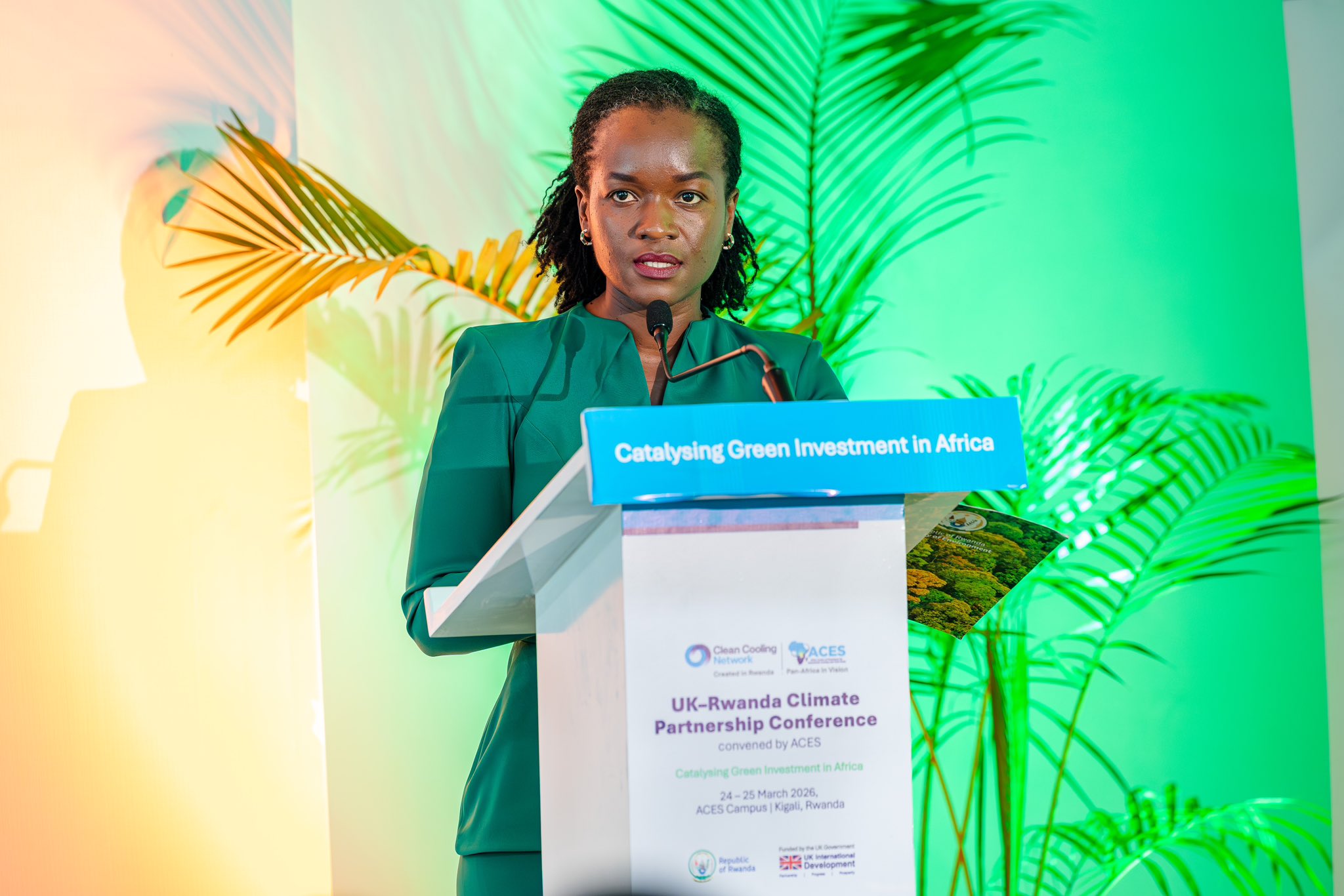
Over 150 global leaders from finance, government, and academia converged at the ACES Rubirizi Campus in Kigali on Tuesday for the UK-Rwanda Climate Partnership Conference. Convened by the Africa Centre of Excellence for Sustainable Cooling and Cold Chain, ACES, the meeting is part of a broader ambition to position Rwanda as a continental hub for green investment.
While the event celebrated a longstanding partnership, the subtext was a pivot in climate diplomacy. The UK government, which has already funneled over £20 million into the program, is signaling a move away from traditional “grant-only” models toward “catalyzing private investment” at scale.
THE BIG LAW
Climate ambition is cheap; delivery systems are expensive.
Across Africa, roughly 40% of food production is lost post-harvest, largely due to a lack of reliable cold-chain infrastructure. In Rwanda, that figure sits at over 30%.
The consensus in Kigali is that the “technology gap” is actually a “systems gap”. Money alone hasn’t fixed the problem because equipment often sits idle due to a lack of spare parts, specialized technicians, or regulatory standards. ACES is designed to bridge this by integrating:
- Workforce Readiness: Training the next generation of engineers to maintain green tech.
- Market Architecture: Testing and certifying equipment to de-risk investment for the private sector.
- Hub-and-Spoke Model: Using Rwanda as the central “Hub” to send knowledge and “SPOKES” out to other African markets.
THE VIEW FROM KIGALI
For Rwanda, this isn’t just about “saving lettuce”—it’s about economic sovereignty. Hon. Dr. Bernadette Arakwiye, Rwanda’s Minister of Environment, noted that the lack of cold chains is a direct hit to farmer incomes and vaccine security.
“This is the moment to move from ambition to execution,” she said, pointing to policy clarity, institutional alignment and ACES as a platform to anchor capability, innovation and investment.
She also challenged how infrastructure is perceived.
Cold chains, she argued, should not be treated as a cost, but as a strategic investment with economic, social and environmental returns.
ROOM FOR DISAGREEMENT
The pivot toward private finance (green bonds, carbon markets, and thematic bonds) comes at a time when grant funding from major multilateral funders is perceived to be shrinking or becoming harder to access.
Critics often argue that relying on private capital for essential “public good” infrastructure like health cold chains can lead to uneven access. However, Gwilym Jones, FCDO’s East Africa Climate and Environment advisor, argues that sustainable, privately funded mechanisms are the only way to ensure these systems “endure into the long term” rather than dying out when a grant cycle ends.
“This partnership is about moving beyond declining grant funding and unlocking private investment at scale—through the Rwanda Green Fund, we’re building an investment facility to attract both local and international capital into key climate sectors.” — Gwilym Jones
For Prof. Toby Peters, Executive Director of ACES, the urgency is clear:
“We need to solve cooling and cold chain—and we need to do it quickly. This is about bringing urgency to unlock funding and getting the private sector, government and communities working together now, not years from now.” — Prof. Toby Peters

KNOW MORE: THE MANDATE FOR ACCOUNTABILITY
President Paul Kagame has already flagged cold chain gaps as a national priority, calling for immediate action and accountability across government.
Minister Arakwiye outlined three areas that now define that response:
- Scaling infrastructure through a national network of packhouses, cold rooms and refrigerated transport.
- Investing in skills so that every unit installed is maintained and performs reliably.
- Strengthening standards to ensure all equipment meets efficiency and environmental benchmarks that can attract long term investment.
THE TAKEAWAY
What is emerging from the UK Rwanda partnership is a rewrite of the climate finance playbook.
The focus is shifting from funding projects to building markets. From isolated interventions to systems that can sustain themselves.
CABN Analysis
As ACES takes shape, Rwanda is positioning itself as a hub for exporting knowledge and expertise in cooling technology across the East African Community (EAC). The real test now lies in how the initial £20 million in UK support translates into unlocking larger flows of private capital.
For farmers on the ground, however, success is not defined by billions raised.It is reflected in something far simpler; Whether their harvest reaches the market before it spoils.
 CABN Contributor