


https://www.youtube.com/watch?v=IyZ1WIua_1s
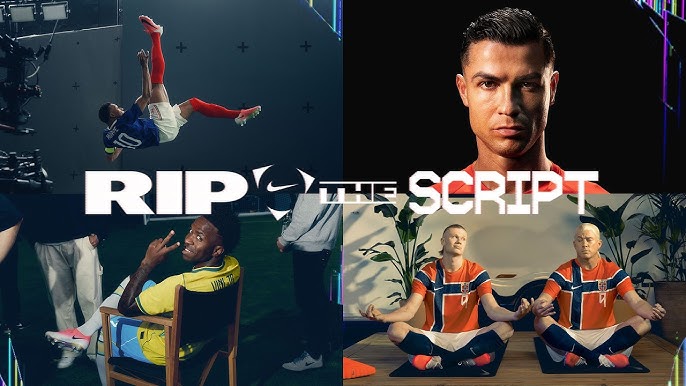
Nike has always understood that great advertising isn’t merely about selling products; it’s about creating moments that become part of culture. With its latest FIFA World Cup campaign, “Rip the Script,” the sportswear giant has delivered something increasingly rare in the age of fragmented media: an advertisement that feels like an event.
Featuring an eclectic cast that includes Cristiano Ronaldo, Kylian Mbappé, LeBron James, Travis Scott, Kim Kardashian, and even Ted Lasso, the campaign blurs the lines between sport, entertainment, music, and celebrity culture. In doing so, Nike has produced perhaps the most ambitious football commercial in years — one that feels simultaneously nostalgic and distinctly modern.
A Return to the Golden Age of Football Advertising
For many fans, “Rip the Script” evokes memories of Nike’s legendary campaigns of the late 1990s and early 2000s. The frenetic pacing, cinematic storytelling, and larger-than-life personalities immediately recall the company’s iconic 1998 World Cup commercials, which transformed footballers into superheroes and elevated advertising into popular culture.
At a time when most campaigns are optimized for short social media clips and fleeting engagement, Nike has gone in the opposite direction. “Rip the Script” embraces spectacle. It is bold, theatrical and unapologetically entertaining — a throwback to an era when brands aimed to create mythology rather than algorithms.
The result is a commercial that feels retro without being dated.
Football Goes Full Hollywood
Perhaps the campaign’s most striking feature is its crossover appeal. Football remains the central narrative, but the supporting cast reads more like the guest list at an Oscars afterparty.
LeBron James brings basketball royalty. Travis Scott represents music and youth culture. Kim Kardashian embodies celebrity and mainstream entertainment. The inclusion of Ted Lasso, arguably one of the most influential television series in introducing football to American audiences, underlines how deeply the sport has penetrated popular culture.
This isn’t merely a football commercial.
It’s Hollywood.
Nike has effectively transformed the World Cup into a shared entertainment experience, one where sports stars, musicians, actors, and celebrities occupy the same universe. In many ways, “Rip the Script” resembles the crossover spectacles traditionally associated with Marvel movies rather than conventional advertising.
A Distinctly American Vision of Football
Unlike previous World Cup campaigns that were heavily European or Latin American in tone, “Rip the Script” feels unmistakably American.
Its celebrity-driven storytelling, cinematic production values, and embrace of pop culture reflect a uniquely American approach to sports entertainment. Football is no longer presented as a foreign game trying to win over North America; instead, it is portrayed as a mainstream cultural phenomenon already woven into the fabric of American life.
That shift is significant.
With the United States, Canada, and Mexico hosting the 2026 FIFA World Cup, Nike’s campaign serves as both advertisement and cultural statement: football has arrived in North America, and it intends to occupy the center stage.
Building Football’s Next Frontier
The World Cup has traditionally been football’s greatest catalyst for growth. But in North America, where basketball, American football, baseball, and hockey have historically dominated, mainstream adoption has often depended on cultural relevance as much as sporting success.
This is where “Rip the Script” could prove transformational.
By bringing together athletes and celebrities who command enormous followings outside football, Nike is introducing the game to audiences who might never actively seek it out. Fans of LeBron James, followers of Kim Kardashian, or listeners of Travis Scott are suddenly engaging with World Cup conversations.
The campaign effectively expands football’s ecosystem beyond traditional supporters.
For Canada and the United States, where younger generations are increasingly global in their tastes and media consumption, that crossover could accelerate football’s rise from a growing sport to a mainstream entertainment property.
Advertising as Cultural Event
In an era when most commercials disappear within days, “Rip the Script” has achieved something remarkable: people are talking about the advertisement itself.
That’s what made Nike’s classic campaigns legendary, and it’s what makes this latest effort stand out. It is not simply selling boots or jerseys. It is selling a feeling — one of anticipation, possibility, and belonging to a global spectacle.
Nearly three decades after redefining football advertising in 1998, Nike appears to have rediscovered the formula that made it the industry’s creative benchmark.
“Rip the Script” is not just a World Cup campaign.
It is a reminder that advertising, when executed with ambition and imagination, can still become part of culture.
And with Hollywood flair, American storytelling, and football at its core, Nike may have just delivered the blockbuster trailer for the sport’s North American future.