
US and Israel Strike Iran as East African Airlines Suspend Middle East Flights
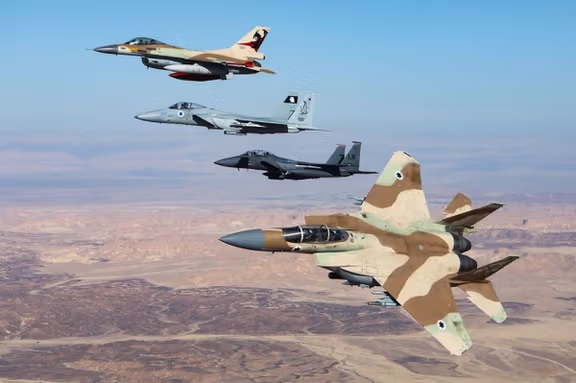
The United States and Israel on February 28 launched coordinated preemptive military strikes on Iran, targeting nuclear facilities, military infrastructure, and elements of the country’s leadership structure — a move that marks a dramatic escalation into open conflict.
U.S. President Donald Trump confirmed that “major combat operations” are underway, framing the strikes as necessary to neutralize what Washington and Tel Aviv describe as imminent security threats. He warned that further action could follow if Iran retaliates, and signaled support for broader political change inside the country.
Iran has yet to outline the full scope of its response, but regional analysts expect retaliatory measures that could extend beyond direct confrontation.
Why This Matters Globally
The Middle East sits at the heart of global energy markets, shipping lanes, and geopolitical alliances. Any sustained escalation risks disrupting oil flows through the Strait of Hormuz — a chokepoint that handles roughly a fifth of global petroleum supply.
Energy markets are expected to react sharply, with oil price volatility likely in the immediate term. Aviation routes, shipping insurance premiums, and global risk sentiment could all see upward pressure.
The conflict also raises the risk of a broader regional alignment shift, potentially drawing in proxy groups and allied states across the Gulf and Levant.
Immediate Aviation Disruptions in Africa
While the fighting is geographically distant, Africa is not insulated from the fallout.
The conflict has already triggered aviation fallout across East Africa.
Ethiopian Airlines, Kenya Airways, and RwandAir have suspended select Middle East routes amid security concerns and airspace uncertainty.
Gulf hubs such as Doha and Dubai serve as critical transit gateways linking East Africa to Asia, Europe, and North America. Route suspensions and potential airspace rerouting are expected to increase operational costs, delay cargo shipments, and disrupt passenger connections.
For Kigali, Nairobi, and Addis Ababa — all positioning themselves as regional aviation hubs — the disruption highlights how quickly geopolitical risk can ripple into commercial aviation strategy.
Energy Markets on Edge
The Middle East remains central to global oil supply. Any sustained escalation raises the risk of disruption through the Strait of Hormuz, one of the world’s most critical energy chokepoints.
Oil price volatility is likely in the short term. For energy-importing African economies, including much of East Africa, higher crude prices could translate into:
- Increased fuel import bills
- Renewed inflationary pressure
- Strain on foreign exchange reserves
- Wider trade deficits
Countries operating fuel subsidy programs may also face renewed fiscal stress.
East Africa’s Economic Exposure
East Africa’s exposure extends beyond aviation.
The Middle East hosts a significant East African diaspora workforce. Remittances from Gulf states are a major source of foreign currency inflows for several countries in the region. Prolonged instability could disrupt labor markets or financial flows.
Shipping insurance costs and freight rates may also rise if maritime tensions escalate, affecting import-dependent economies reliant on Gulf-linked trade routes.
Broader Geopolitical Implications
The strikes signal a potential restructuring of regional power dynamics. A wider confrontation could pull in proxy actors and global powers with strategic interests in the Gulf.
African governments balancing diplomatic relationships between Washington, Gulf capitals, Beijing, and Moscow may find foreign policy positioning increasingly complex.
Markets are now watching three immediate variables:
- The scale and timing of Iran’s retaliation
- Whether energy infrastructure becomes a direct target
- The duration of sustained U.S. military engagement
What Comes Next
If the conflict remains contained, market volatility may stabilize. But if escalation broadens, Africa — particularly East Africa — could feel the impact through higher energy costs, disrupted aviation networks, and strained fiscal balances.
The coming days will determine whether this remains a limited military operation or evolves into a wider regional confrontation with global economic consequences.