


Kigali, April 10, 2026 – Rwanda’s annual inflation rate remained unchanged at 9.2 percent in March 2026, underscoring persistent price pressures even as the monthly pace slowed slightly across some major categories, according to the National Institute of Statistics of Rwanda (NISR).
The Urban Consumer Price Index, the main gauge used for monetary policy, also rose 9.2 percent year on year, matching February’s reading, while increasing 1.3 percent month on month. NISR said the annual average urban inflation rate stood at 7.6 percent between March 2025 and March 2026.
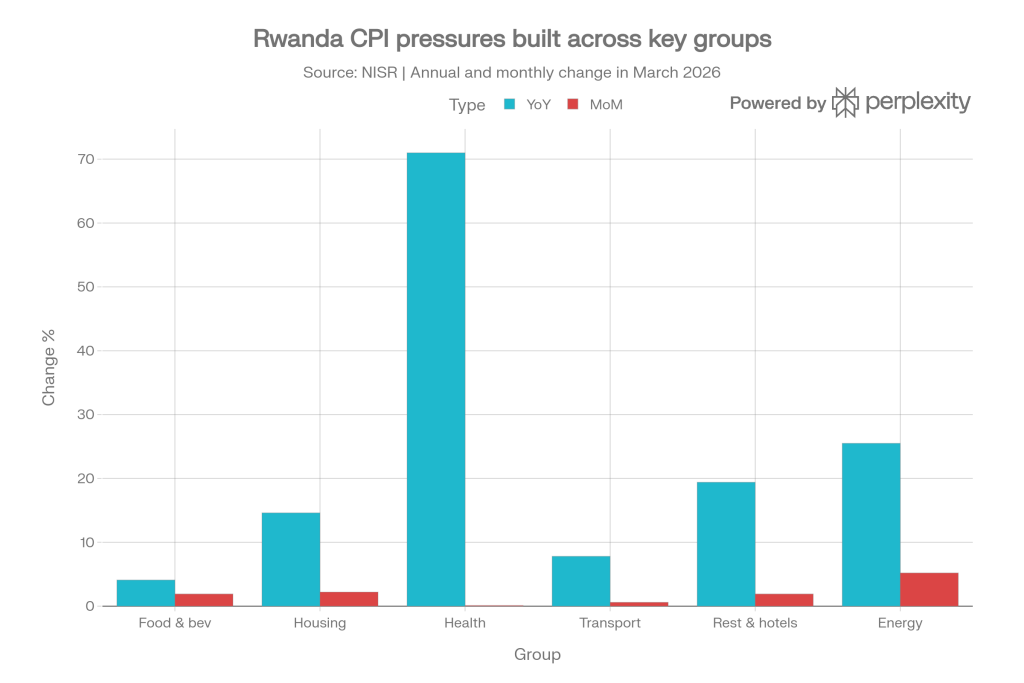
Food prices continued to climb, but at a more moderate annual pace than the broader index. “Food and non-alcoholic beverages” rose 4.1 percent year on year and 1.9 percent month on month, while “restaurants and hotels” increased 19.4 percent annually and 1.9 percent monthly, pointing to stubborn cost pressures in both households and the services sector.
The biggest pressure point remained housing and utilities. “Housing, water, electricity, gas and other fuels” jumped 14.6 percent year on year and 2.2 percent month on month, while energy prices rose 25.5 percent annually and 5.2 percent on a monthly basis. NISR also reported a 71 percent annual rise in health costs, although the monthly increase was only 0.1 percent.
Imported goods climbed 8.7 percent year on year, compared with a 9.4 percent rise in local goods, suggesting that both external and domestic cost factors are feeding inflation. Fresh products were up 4.1 percent annually and 2.5 percent monthly, while the core index excluding fresh products and energy advanced 9.4 percent year on year and 0.6 percent month on month.
The figures point to an inflation picture that is not easing quickly, even if the headline rate has stabilized. With transport prices up 7.8 percent annually and alcoholic beverages, tobacco and narcotics rising 17.8 percent, the March data show broad-based pressure across consumer spending.
Market reading
For policymakers, the latest CPI print suggests the battle against inflation is not yet won. The flat annual headline rate may offer some comfort, but the strong monthly gains in energy, housing and restaurant costs indicate that price shocks are still flowing through the economy.
For households, the message is simpler: the cost of living remains high, and relief has been uneven. Essentials such as food and utilities are still rising, while even discretionary spending categories continue to feel the squeeze.
 CABN Contributor